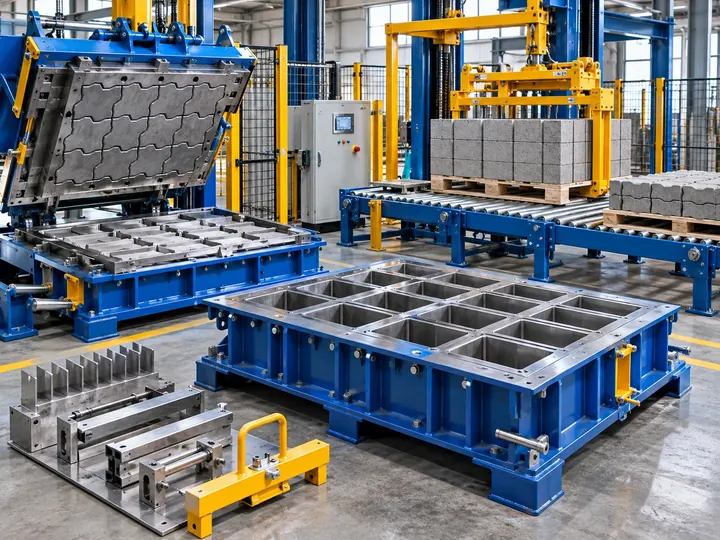

Product moulds and tooling for dimensional repeatability, product flexibility and controlled changeovers.
Role in the Production Line
Moulds & Product Tooling should be evaluated as part of the complete material and product flow. Upstream and downstream equipment must be matched so that one process does not become the bottleneck for the whole plant.
Configuration Priorities
In the context of Moulds & Product Tooling, key priorities include target product dimensions, concrete characteristics, automation expectations, changeover frequency, operator organization, maintenance access and the planned production schedule.
Selection Approach
In the context of Moulds & Product Tooling, the best configuration is the one that can repeatedly manufacture the required products with a practical balance of quality, output, serviceability and investment scope. Headline capacity alone is not a sufficient selection criterion.
How This Machinery Group Is Used
Moulds & Product Tooling covers tooling that creates concrete product geometry and transfers compaction forces into the fresh mix. The category should be evaluated as part of the complete production process, not as a stand-alone purchase. A technically sound project begins with the products that will be sold, the number of shifts, expected production volumes and the condition of local raw materials. Those inputs determine which equipment is essential, which options add real value and which items can be reserved for later expansion. This approach avoids building a factory around a headline capacity that does not match the actual market or product mix.
Translate Product Demand Into Technical Requirements
The main selection questions for Moulds & Product Tooling are approved product drawing, cavity arrangement, pallet utilization, mould-box height, tamper geometry, steel and wear allowance. Product drawings and expected sales mix should be prepared before final equipment sizing. High-volume standard products and occasional specialty products may justify different tooling, changeover and buffer strategies. Where several configurations are possible, compare them using the same operating assumptions. This makes it easier to see whether a larger machine genuinely creates more saleable output or simply increases capital cost and supporting equipment requirements.
Check Every Interface in the Production Flow
Capacity for Moulds & Product Tooling depends on its connection with machine frame, feed drawer, mould clamping, tamper head, pallet support, lifting and storage. The slowest required process determines factory output. Upstream shortages create machine waiting; downstream shortages create pallet congestion, excessive work in process or unplanned stops. During layout review, calculate peak and average flow, identify buffers and confirm how the plant behaves during short interruptions. A balanced line usually delivers better shift output than a system built around one oversized station because operators can maintain a steady rhythm without constantly recovering from accumulation or starvation.
Measure Quality at the Process Source
Key quality objectives for this category include dimensional accuracy, balanced fill, controlled release, edge condition and repeatable height across cavities. Checks should be linked to process variables that can be corrected during production. Approved product drawings, reference samples and recorded recipes provide a stable baseline after maintenance, tooling changes or new raw-material deliveries. Trend data is more valuable than isolated measurements because gradual wear and material drift can be recognized early. When a defect appears, the team should review material condition, equipment condition, settings and handling in a logical order instead of changing several variables at the same time.
Choose an Appropriate Automation Level
Daily operation of Moulds & Product Tooling can involve changeover, cleaning, inspection, clearance checks, safe lifting, repair and protected storage. Automation should reduce unnecessary manual work and variation while keeping the process understandable to operators. Recipe permissions, alarm history and safe recovery modes should be defined during commissioning. Training should explain why critical limits exist and how one station affects the next. This is especially important in an integrated plant, where a local adjustment can move the bottleneck or create a quality problem several stages later.
Plan Maintenance Before Installation
Reliability planning should identify wear items, critical spares and maintenance access before installation. The factory should distinguish daily cleaning and inspection from periodic adjustment and shutdown work. Critical parts should be stocked according to lead time and the production consequence of failure, not simply unit price. Replacement history, recurring alarms and abnormal wear should be recorded. For Moulds & Product Tooling, a maintenance-friendly arrangement improves long-term availability because technicians can isolate, inspect and replace components without dismantling unrelated equipment or blocking the production area.
Coordinate Machinery With the Building
Final engineering must coordinate Moulds & Product Tooling with foundations, floor loads, clear height, doors, cranes, electrical distribution, compressed air, water, drainage and material logistics as applicable. Service envelopes belong on the layout together with operator and forklift routes. Export projects should also consider shipping dimensions, unloading equipment and installation sequence. Reserving sensible expansion space is usually inexpensive during initial construction and very expensive after permanent structures or utilities have been placed in the only practical growth area.
Compare Complete Installed Cost
The investment case should include mould life, pieces per cycle, changeover time, wear inserts, product range and spare tooling. Purchase price is only one part of the decision. Labour, consumables, maintenance, rejects, energy and downtime can change the economics significantly over several years. The highest automation level is not always the best starting point, and the lowest initial cost may restrict growth. Compare a realistic base-demand case with an expected-growth case, then identify which upgrades can be added later without replacing major equipment. This creates a clearer path from initial production to a mature factory.
Questions to Resolve for Moulds & Product Tooling
Before this machinery group is released for final engineering, the customer and supplier should agree the product drawings, target volumes, operating hours and the assumptions behind approved product drawing, cavity arrangement, pallet utilization, mould-box height, tamper geometry, steel and wear allowance. The discussion should also cover how machine frame, feed drawer, mould clamping, tamper head, pallet support, lifting and storage will be supplied, controlled and maintained under normal plant conditions. If the factory expects a wide product range, identify which changes require tooling, recipe changes, extra cleaning or additional handling. If expansion is expected, define which interfaces and building areas must remain available. These decisions give the category a clear role in the factory and prevent optional equipment from being selected without a specific production reason.